| Uwe Wahser: Construction of an Adapted Health Information System | ||
| Previous File | Overview | Next File |
| Detailed Table of Contents | ||
The application of qualitative methods for analyzing and assessing a given situation is traditionally known from social sciences. Due to its emphasis on the social aspects of health as a complement to the purely medical approach, primary health care also relies on the application of qualitative methods. An introduction into qualitative methods from the viewpoint of health service planners in primary health care is given in [MAIER et al. (1994)]. Qualitative methods are also applicable during the systems analysis phase of a systems engineering project, as shown in section 2.1.2. "Analysis".
The methods which are introduced in [MAIER et al. (1994)] mainly aim at understanding the determinants of health and health seeking behavior of a population. Therefore not all of them are suited for an assessment of information structures within the more formal, administrative part of the health system. It must not be forgotten, though, that the other methods can play a very important part in analyzing the more informal, community based part of a health information system, where it is essential to obtain knowledge about the ways, health and health information is perceived by the population. In the context of this thesis only a selection of methods is applicable. Therefore this section only gives an overview of the methods from [MAIER et al. (1994)], while the techniques which are needed for the systems analysis phase are specified in section 3.2.4. "Assessment of the Objects of Interest" of chapter 3. "Methodology".
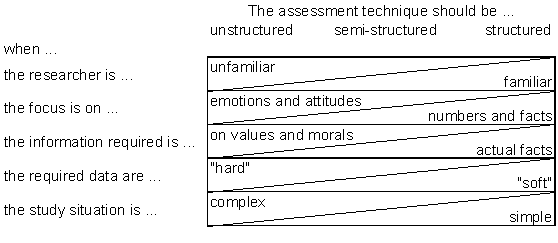
Qualitative methods are understood as open procedures, "trying to determine 'what exists' and 'why it exists' rather than 'how much of it is there'" [MAIER et al. (1994)], p. 3). They are seen as important especially during the planning, and pilot-phase of health projects. While quantitative approaches require a defined problem, qualitative approaches describe "undefined and open situation[s], where knowledge about the problem has to be explored first". The techniques vary between a structured and an unstructured design. The decision for the degree of structure is taken according to the circumstances of the study. Possible motives for a decision in favor a specific assessment technique are given in figure 2.2-1:
Fig. 2.2-1: The decision for the degree of structure of a qualitative assessment technique is based upon the circumstances of the study (modified from [MAIER et al. (1994)], p. 4).
In [MAIER et al. (1994)], three types of qualitative techniques are described:
In this thesis techniques of the first two kinds, interview and observation, are applied.
Interview types for application in the setting of primary health care system concentrate on oral interviews. The personal relation between the interviewer and the interviewees plays an important role. In this context, interviews can be characterized according to their degree of structure and the type of interviewee as demonstrated in table 2.2-1:
| Interviewees | Structure | Example |
|---|---|---|
| Individuals | Unstructured | In-depth interview |
| Semi-structured | Guidelined key informant interview | |
| Structured | Verbal autopsy with a questionnaire | |
| Groups | Unstructured | Narrative group interview |
| Semi-structured | Focus-group discussion | |
| Structured | Group interview with a questionnaire | |
The chosen structure has an effect on the degree, to which the questions are predefined. The structured interview requires a questionnaire with either closed or open-ended questions. It enables a direct comparison and simplifies quantification of the results. It is also well suited to be conducted with the aid of several interviewers. However, a predefined approach is not flexible and bears the danger of producing irrelevant results. The unstructured approach results in a conversational atmosphere, where the discussed topics emerge from the current situation. It is highly suited to be adapted to the personalities of the interviewees and to respect topics whose importance can not be foreseen by the interviewer. It is, however, prone to leave out topics, which do not arise in the course of the interview. The semi-structured approach combines the two extremes. A semi-structured approach requires a definition of the relevant topics in advance. Although it grants a certain freedom for adapting the specific contents of the interview to the circumstances, it is still limited to predefined topics. If these are not exhaustive, important topics might be omitted.
Especially for the semi-structured and unstructured interviews, the interviewer should respect some basic principles. Considering the personal situation of the interviewees, the interviewer should
In addition to this, the interviewer has to make sure that the given information is valid and not biased. Therefore the interviewer should
The many different types of observations can be characterized by their degree of structure and the degree of participation of the observer in the observed activities. Additionally it is important to know, whether the observed group is aware that it is being observed. Table 2.2-2 gives an impression of the resulting variety of observational methods:
| Structure | Role of Observer | Transparency of Observation |
|---|---|---|
| Unstructured | Participatory | Open |
| Hidden | ||
| Non-participatory | Open | |
| Hidden | ||
| Structured | Participatory | Open |
| Hidden | ||
| Non-participatory | Open | |
| Hidden | ||
A structured observation is done with a form which is filled out by the observer. As is the case with structured interviews, this approach enhances the comparability of the results from different observers to a certain degree. It is limited to the topics represented in the form, though. The different roles of the observer describe to which extent the observer is integrated into the observed system. The participatory approach obliges the observer to become part of the system. This time exhaustive method enables the observer to gain a deep insight into the motivations and emotions which are relevant for the observed system. The results tend to be more subjective than those from the non-participatory approach, which puts the observer into a remote position. The decision whether to conduct an open or hidden observation depends largely on how much the observed system might be influenced by the fact that it is being observed. While a hidden observation promises a more authentic behavior of the observed individuals, it has the disadvantage of being ethically questionable.
| Previous File | Overview | Next File |
| Detailed Table of Contents |
| This page was constructed by Uwe Wahser (uwe@wahser.de) Last Revision: May 1996 |
|