2.3. A Multi Level Model for the Description of Information Systems
Complex information systems with heterogeneous components require a tool for structured presentation. In the field of hospital information systems a progressing introduction of multiple computer platforms and a variety of software application products forwarded an evolution of diversified hospital information systems. Additionally, the trend towards more decentralized information processing is obvious. On the grounds of this development, the introduction of an adequate model became mandatory, as an approach "to support the systematic design and control of evolution of computer-supported hospital information systems" ([WINTER and HAUX (1995)]).
JANßEN comprises early efforts of WINTER and GERNETH in [JANßEN (1992)] and describes a multi level model of an information system. He uses this model to construct a computer supported procedure for timely transmission of medical results. The model includes
- a business level,
- an information system level,
- a procedure level,
- a tool level with a logical and a physical view,
- a locality level.
In a more formal elaboration WINTER reduces the above levels in [WINTER (1994)] (to be published in [WINTER and HAUX (1995)]) to
- a procedure level,
- a logical tool level,
- a physical tool level.
Although not explicitly mentioned by the authors, it is obvious, that the levels are arranged according to the degree of abstraction of the view on an information system. The physical tool level in [WINTER and HAUX (1995)] for instance describes the processing and transmission of signals or physical manifestations of data. The logical tool level describes data processing and transmission of messages, which are sets of data. Data themselves do not carry any meaning, but provide a carrier for information. Information processing is described on the procedure level, where information is seen as data, which have a particular meaning in a certain context.
Undoubtedly the motivation for building these models arose mainly because of the growing complexity of the computer-supported part of a hospital information system. But all authors emphasize, that the conventional part is also essential in the respective model. It is therefore no question, that the model is suited to describe information systems, in which computer technology only plays a secondary role, as it is the case in a district health information system.
In sections 2.3.1. "The Business Level" to 2.3.6. "The Locality Level" a description of a multi level system is given as it is applied in this thesis. The description mainly comprises [JANßEN (1992)] and [WINTER and HAUX (1995)]. The definitions of the needed terms are given in the respective sections. The levels form a structure as shown in figure 2.3-1. Each level can be described as a graph, which nodes represent components of that level. The relations between the components are described with arcs connecting the nodes.
Fig. 2.3-1: The different levels of an information system, as they are used in this thesis (modified from [JANßEN (1992)]).
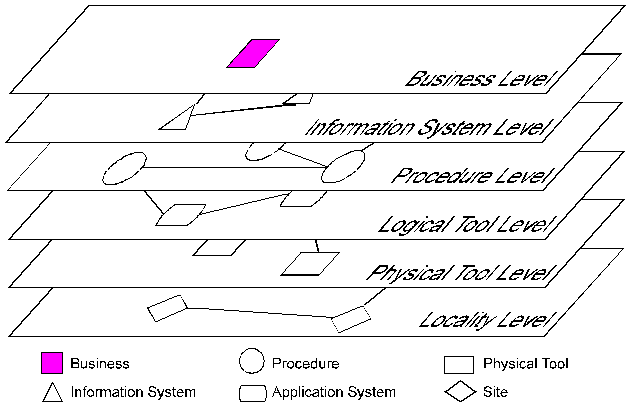
Note that the above mentioned authors evolved a model based on finite graph theory. This is very useful with respect to an evaluation of information systems with the aid of a dedicated software application product. Due to the narrative approach of this thesis, a mere definition of the needed terminology shall be sufficient for the following description. For a visualization of the examples, a graphical presentation of the described terms is used which refers to basic elements from the graph model. Especially the respective instances of outside access to a level were neglected due to simplification.
2.3.1. The Business Level
On the business level, the business of interest and its components are described. A business is defined as an organizational entity with a specific aim. Note that in [WINTER and HAUX (1995)] the business level is not defined as part of the model. In the context of this thesis, the business of interest is a district health system, as it is described in section 1.1. "District Health Systems Based on Primary Health Care".
Example: Let the business of interest be the district health system of the fictional Kurungi District. In figure 2.3-2, it is represented by a square (DHS):
Fig. 2.3-2: The business level of an information system describes the business which applies the information system.

2.3.2. The Information System Level
On the information system level, the single information systems and their interfaces are described. Information systems can also provide interfaces to external information systems or access to the users of the information system. While [JANßEN (1992)] lists the information system level as a separate level, it is evident from [WINTER and HAUX (1995)] that an information (sub-) system must be seen as a subset of objects on the procedure level, the logical tool level and the physical tool level, which are described in the following sections. In this sense, the information system level is kept as a separate level in this thesis. It is used to describe the basic structure of a health information system as it is defined in section 1.2.2. "Definition of Information Systems in District Health Systems".
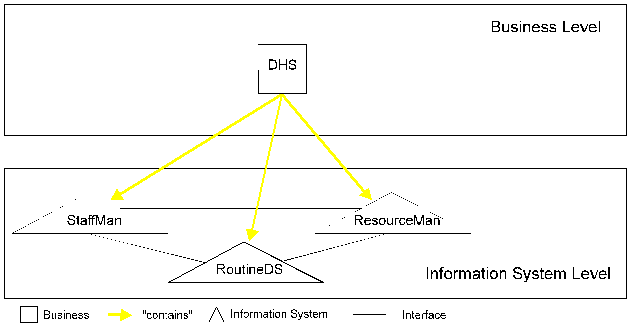
Example: The district health system of the fictional Kurungi District contains a staff management information system (StaffMan), a routine disease surveillance system (RoutineDS) and an information system for resource management (ResourceMan). The single systems have interfaces as depicted in figure 2.3-3:
Fig. 2.3-3: The information system level describes the information systems and their interfaces, which can be found in a business.
2.3.3. The Procedure Level
Each information system consists of a set of information procedures. Information procedures are functional entities of one or more information system which can exchange information. They can also provide a procedure access for information exchange with external procedures or users. The procedures and their information exchange are described on the procedure level.
Example: In the fictional Kurungi District, the following information procedures can be found:
- In the outpatient departments of the health units, all treated cases are registered (CaseReg).
- At the end of each month, a summary of the registered cases is reported from the health unit to the district health team (HURep).
- For each health unit, a yearly estimation of the target population (TPEsti) is done.
- Indicators on the health status of the district population are calculated from the health unit reports and the target populations by IndGen.
The information systems RoutineDS and ResourceMan consist of the following sets of these information procedures:
- RoutineDS consists of {CaseReg, HURep, IndGen}.
- ResourceMan consists of {TPEsti, IndGen}.
Figure 2.3-4 visualizes the information procedures, their information exchange and their assignment to the information systems:
Fig. 2.3-4: The procedure level describes procedures of information systems and their information exchange.

2.3.4. The Logical Tool Level
In an information system, procedures are realized by tools. The logical or intangible tools for data processing are described on the logical tool level. Logical tools are called application systems. They can be either computer based in the form of software application products or of a conventional kind in the form of organizational plans or working algorithms. Application systems can communicate by passing messages through communication links. External communication is done by providing dedicated functions.
Example: In the fictional Kurungi district, the following application systems can be identified:
- RepAlg is a working algorithm for calculating monthly reports of a health unit.
- DEntAlg is an organizational plan of how data from the health unit have to be entered into the computer.
- StatSoft is a commercial software application product, which is especially designed for automating statistical calculations.
- EstiAlg is a working algorithm, according to which the estimation of target populations for a health unit is done.
The application systems realize the procedures HURep, IndGen and TPEsti in the following way:
- HURep is realized by {RepAlg}.
- IndGen is realized by {DEntAlg, StatSoft, EstiAlg}.
- TPEsti is realized by {EstiAlg}.
Figure 2.3-5 shows the resulting structure:
Fig. 2.3-5: The logical tool level describes the application systems of an information system and their communication links.

2.3.5. The Physical Tool Level
Application systems need physical tools to work. These are described on the physical tool level. Physical tools can be either persons, conventional physical tools or computer systems. Physical tools can transmit signals or data, to stay with the terminology used by JANßEN and WINTER.
Example: The application systems of the information system of the fictional Kurungi use physical tools in the following way:
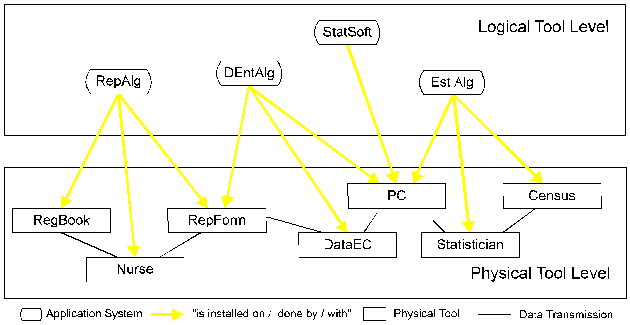
- According to RepAlg the data from the register book (RegBook) are summarized by a nurse (Nurse) and entered into the monthly report form (RepForm). RegBook contains a list of all the treated cases in the outpatient department.
- According to DEntAlg the data from the report forms (RepForm) of all health units are entered into the personal computer (PC) by a data entry clerk (DataEC).
- According to EstiAlg the results from a publication of the latest national household survey (Census) are used to calculate target populations for each health unit by the statistician (Statistician). Afterwards the statistician enters the target populations into the personal computer (PC).
- The commercial software application product for statistical calculations (StatSoft) is installed on the personal computer (PC). It uses the entered data sets for the generation of indicators.
In figure 2.3-6 the resulting structure of the physical tool level is presented:
Fig. 2.3-6: The physical tool level describes persons, conventional physical tools and computer systems which enable application systems of an information system.
2.3.6. The Locality Level
Although the locality level is not discussed in [WINTER and HAUX (1995)], it is adopted from [JANßEN (1992)] for this thesis. The locality level describes the sites, where the physical tools of an information system can be found. Especially for information systems which use many conventional physical tools, a look at the locality level can give a better understanding on limitations of an information system. This is the case in a district health system, where the providing and the planning components are separated not only by distance, but also by difficult accessibility of sites due to uncertain road conditions.
Example: In the fictional Kurungi district, the physical tools for information processing are located at the following sites:
- {RegBook, Nurse, RepForm} are located at each health unit (HU) in the district.
- {DataEC, PC, Statistician, Census} are located at the statistics office (StatOff) in the district capitol.
It is obvious, that good transport facilities are essential for a functioning health management information system of the district health system. Figure 2.3-7 depicts the location of the physical tools at the different sites:
Fig. 2.3-7: The locality level describes the sites, where the physical tools of an information system are located.
