Uwe Wahser: Construction of an Adapted Health Information System
Previous File Overview Next File
Detailed Table of Contents

4. Realization

This chapter describes the realization of the methodology from chapter 3. "Methodology". It mainly describes the activities which were carried out in the context of the systems engineering project and gives a broad summary of the results. Detailed results can be found in the annexes R "Report: 'The Kabarole District Health System - Description, Opportunities and Suggestions for Improvement'" and M "The 'Kabarole!' Manual". These are referenced when appropriate.

4.1. Planning

As expected, the planning of the systems engineering project was limited due to communication restraints. It was possible to arrange a meeting with the manager of the GTZ basic health project in February 1994, during which a broad conceptual discussion of the topic of the systems engineering project took place. After the meeting the aim and objectives were defined by the author and submitted to the district health team. With the clarification of the economical framework and the time scheduling of the involved parties in Fort Portal it was finally possible to propose three broad phases for the whole systems engineering project. Central part formed phase 2 with the actual deployment in the district health system. Table 4.1-1: lists the planned phases:

Tab. 4.1-1: The whole systems engineering project was distinguished into three broad phases.

PhaseDurationActivities
1April - May 1994Location: Heidelberg, Germany
Conduction of
- the planning phase,
- an initial document analysis.
2June - October 1994Location: Fort Portal, Uganda
Conduction of
- the systems analysis phase,
- the evaluation phase,
- the generation of the intermediate report,
- the selection and construction of system components,
- the implementation of system components.
3starting from December 1994Location: Heidelberg, Germany
Conduction of
- the supplementation of system components (eg. Users' Manual),
- the final reporting.
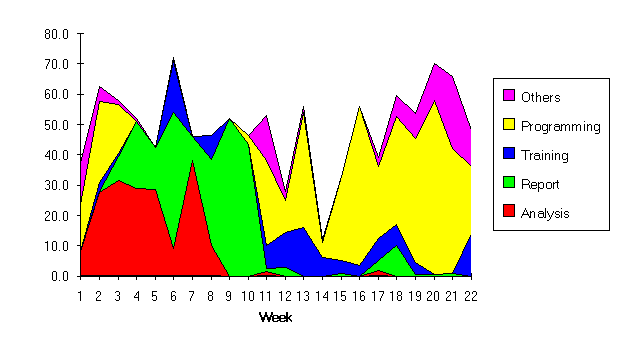
A detailed planning of phase 2 was not possible without a more detailed knowledge of the settings in the district. As a broad guideline one to two months were estimated for the systems analysis and evaluation. The selection and construction of system components had to take place in the remaining three months. The actual time scheduling for the analysis had to be done in Fort Portal in agreement with the district health team. The resulting distribution of activities during the whole deployment of actually 22 weeks is depicted in figure 4.1-1. The activities were comprised into the categories "Analysis" of the health information system, "Reporting" on the results of the systems analysis and the evaluation, "Training" of data-entry clerks and other district health team staff, "Programming" of the software application product and "Others", which includes organizational activities and miscellaneous supportive tasks within the district health team.

Fig. 4.1-1: The distribution of activities shows the beginning of the construction phase after the tenth week of deployment in the district.

fig41-1.gif

Previous File Overview Next File
Detailed Table of Contents
This page was constructed by Uwe Wahser (uwe@wahser.de)
Last Revision: May 1996